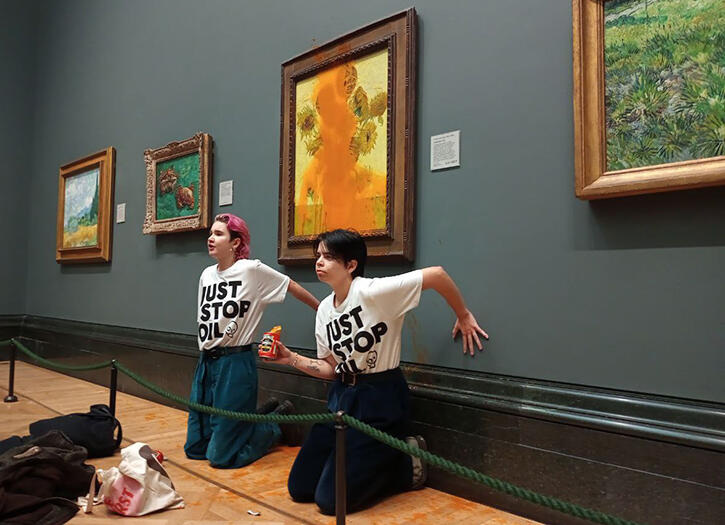
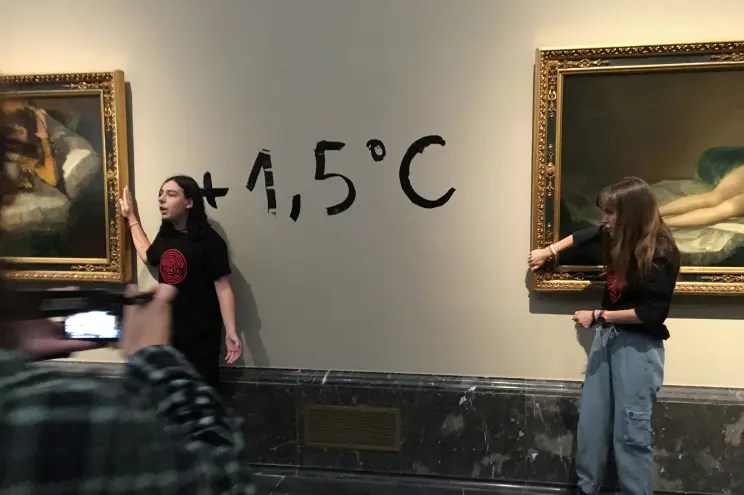
Bu sıralar belli başlı müzelerde yer alan popüler sanat yapıtlarına art arda saldırılar düzenleniyor. Protestoların amacı hükümetlerin iklim krizine karşı duyarsız kalmalarıyla birlikte yeni fosil yakıt projelerini destekleyen kararlar almaya devam etmeleri… İngiliz hükümetinin 100 yeni fosil yakıt projesi gündemi dolayısıyla “Just Stop Oil” koalisyonu (coalition of movements) Londra’nın her yerinde bu duyarsızlığa karşı eylemlerini sürdürmeye devam edeceğini ilan etti. Koalisyonun diğer ülkelerde farklı isimlerde uzantıları mevcut. (Last Generation – Almanya, Save Old Growth – Kanada vb.) Just Stop Oil şimdiye kadar National Gallery‘de bulunan Van Gogh’un Sunflowers yapıtına konserve domates çorbası, Museum Barberini‘de (Almanya) bulunan Monet’nin Haystack tablosuna patates püresi fırlattı. (Bu yazıya devam ederken, protestocuların bu sefer Madrid Prado Müzesi‘ndeki Goya tablolarına ellerini yapıştırdığı haberi geldi; Protestocular ellerini çerçeveye yapıştırarak bildilerini okudular.)
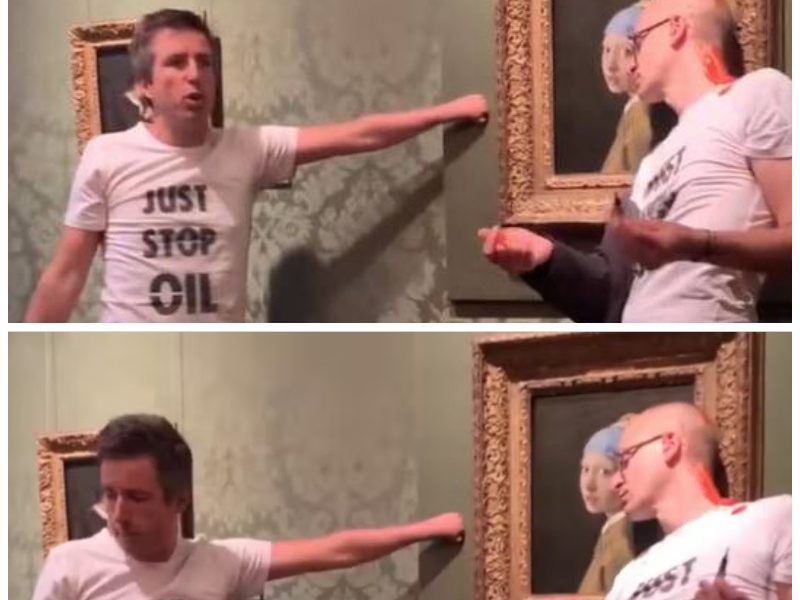
Koalisyonun ilginç eylemlerinden biri de Vermeer’in Girl With a Pearl Earring (İnci Küpeli Kız) ismindeki ünlü tablosuna yönelikti. Bu sefer protestoculardan biri kafasını doğrudan tablonun üzerine yapıştırmayı tercih etti. Diğer protestocu ise bir yumruğunu duvara sabitlerken öteki eliyle elindeki domates püresini tabloya yapışık olan arkadaşının kafasına boca etti. Türlü absürt şeyleri bir araya getiren mizansenin görünürde bir tek amacı vardı: İlgi çekmek. Sanat yapıtı ise bu mizansenin biricik sahnesiydi.
“Just Stop Oil“in üyeleri Frieze dergisine verdikleri röportajda protestolarının sanat eserleriyle bağlantısını şöyle kuruyorlar: “Çünkü sanat eseri muazzam kültürel bir değer. Nihayetinde insanlar taleplerimiz ve mesajımız hakkında konuşuyor.”
Protestocular sanat eserlerinin cam ile korunduğunun farkındaydı. Hatta bununla ilgili duymamızı istedikleri şu çıkarımları var: “Resim camın arkasındaydı, korunuyordu fakat küresel güneydeki (Global South) milyonlar korunmuyor, gelecek jenerasyonlar korunmuyor. Genç insanlar olarak kendi geleceklerimiz korunmuyor.“
Muhabirin eserin camla korunduğunu vurgulaması ve protestocuların bunu bildiğini söylemesi aslında saldırının cama yönelik olduğunu gösteriyor. Üstelik müzelerin açıklamalarında eserin cam sayesinde zarar görmediği ilk verilen bilgiler arasındaydı. Camın hayati bir önem taşıdığı bir gerçek. Peki cam neyi imgeliyor? Camın imgesel bağlantılarına, görünür gerçekliği bükerek ulaşmayı deneyebiliriz:
Cam olmasaydı eser zarar görecekti. Ona tanık olan herkes bunun farkında ve ilk başta zannedilen de oydu demek yanlış olmaz. Dolayısıyla görüntüleri izledikten sonra veya haberi duyduktan sonra saf halde ilk verilecek tepkide cam “yok”tur. Patates püresinin sanat eserine fırlatılışının görüntüsü vardır. Yeterli bilgiden yoksunluk okur veya izleyicide sadece şoku tetikler.
Protestocuların camın varlığını bilmesi ve müzenin camın varlığından dolayı duydukları memnuniyete gelirsek burada bilginin mekânında olduğumuzu söyleyebiliriz. Camın varlığı şok etkisini dindiriyor. Cam olduğu için olaya tepki gösterenlerin içlerine su serpiliyor diyebiliriz. Peki bu yeterli midir? Önemli olan sanat eserinin önündeki camın püreyi engellemesi midir? Protestocu camın olduğu “bilgi”sine rağmen eylemini devam ettirmesi bize başka bir şey anlatıyor: Asıl hedef camın kendisidir. Cam, eseri fiziken korumakla birlikte esere olan beğeniyi, görüşleri, geçmişini, eserin tüm kültürel izlerini koruma altına alıyor. Bu anlamda yokluğu şoka sebep olmasını sağlayan her türlü imgeyi koruduğunu söyleyebiliriz. Bunu saldırının yarattığı şok dalgasından güzel bir şekilde görmüş olduk. Doğrudan esere olabilecek saldırı eserin izleyiciyle, mekanla veya her türlü ekonomiyle olan ağını bozacak veya sarsacaktır.
Performans sonu sergilemiyor. Sonu anımsatıyor. Tablolara zarar verme ihtimaline en yakın bir durumla karşı karşıyayız ve bu durum bizi tabloya zarar gelmesinden daha fazla etkiliyor olabilir. Tablonun yok olması bir son ise ona zarar verme niyetiyle yaklaşmayı sürdürmek kaygı üreten bir durum. Bu kaygıya şimdi her zamankinden daha çok ihtiyacımız var. Sanat eserleri, sanat tarihinin bir meselesi olmasının ötesinden dünya miras ağının, insanlığın hayal gücünün bir parçası olarak her gün yeniden üretiliyor. Onlar, her gün yeni bir sözün baş aktörü oluyorlar. Müzelerin bu türden olayları ağırlamaya başlaması, insanların konfor alanının tekinsizliğine, hayal gücü depolarının da zarar görme ihtimaline işaret ediyor.
Dikkatli olalım. Ellerimiz çerçeveye yapışmak zorunda. Yoksa ortada tablo kalmayacak.
GLUE, PUREE AND MASTERPIECE: NEW ELEMENTS OF ANXIETY
These days, attacks are being carried out on famous artworks in some museums. The purpose of the protests is for governments to continue to make decisions supporting new fossil fuel projects, despite their insensitivity to the climate crisis… Due to the British government’s plan for 100 new fossil fuel projects, the “Just Stop Oil” coalition has taken action against this insensitivity all over London. He declared that he would continue to do so. The alliance has extensions in other countries with different names. (Last Generation – Germany, Save Old Growth – Canada, etc.) Just Stop Oil threw canned tomato soup to Van Gogh’s Sunflowers, which has so far been in the National Gallery, and mashed potatoes to Monet’s Haystack painting at Museum Barberini (Germany). (While writing this post, news came that the protesters had glued their hands to Goya paintings, this time at the Madrid Prado Museum; the protesters read their words by sticking their hands on the frame.)
One of the notable acts of the coalition was Vermeer’s famous painting Girl With a Pearl Earning. One of the protesters chose to stick his head directly on the painting this time. The other protester pinned a fist to the wall, while with the other hand he poured the tomato puree on the head of his friend who was stuck to the painting. While combining all kinds of absurd things, the mise-en-scène had only one apparent purpose: to attract attention. The artwork was the only scene of this mise-en-scene.
In an interview with Frieze magazine, “Just Stop Oil” members link their protest to works of art:
“Because the artwork is a tremendous cultural asset. After all, people are talking about our demands and our message.”
The protesters were aware that the artworks were protected by glass. They even have the following inferences they want us to hear:
“The picture was behind the glass, what protected it, but the millions in the Global South are not protected, future generations are not protected. Our futures as young people are not protected.”
The fact that the reporter emphasized that the work was protected by glass and that the protesters knew about it, shows that the attack was directed against the glass. Moreover, in the explanations of the museums, it was among the first pieces of information that the glass did not damage the work. It is a fact that glass is of vital importance. So what does the glass visualize? We can try to reach the imaginary connections of glass by bending visible reality:
Without the glass, the work would have been damaged. Everyone who witnessed him knows this, and it would not be wrong to say that he was the first thought. Therefore, the first reaction to being given in pure form after watching the images or hearing the news is “no” glass. It has the idea of mashed potatoes being thrown into the artwork. Lack of sufficient information only triggers shock in the reader or viewer.
As for the protesters’ knowledge of the existence of glass and the museum’s satisfaction with the reality of glass, we can say that we are in a space of knowledge here. The presence of glass relieves the shock effect. We can say that because it is glass, water is sprinkled on those who react to the incident. So is this enough? Is it essential that the glass in front of the artwork blocks the puree? The fact that the protester continues his action despite the “information” that the glass is in tells us something else: The real target is the glass itself.
Along with physically preserving the work, the glass protects the work’s taste, views, history, and all cultural traces. In this sense, we can say that it preserves all kinds of images whose absence causes shock. A direct attack on the work will disrupt or shake the network of the work with the audience.
The performance does not show “the end”; It reminds you of it. We are faced with a situation most likely to damage the paintings, which may affect us more than damage the painting. If the disappearance of the painting is an end, continuing to approach it to harm it is a state of anxiety. We need this anxiety now more than ever. Beyond being a matter of art history, masterpieces are reproduced every day as a part of the world heritage network, the imagination of humanity. They become the protagonist of a new word every day. The fact that museums start to host such events points to the uncanny nature of people’s conformity space and the possibility of damaging their imagination.
Be careful. Our hands have to cling to the frame. Otherwise, there will be no “scene” left.
 Görsel Kültür